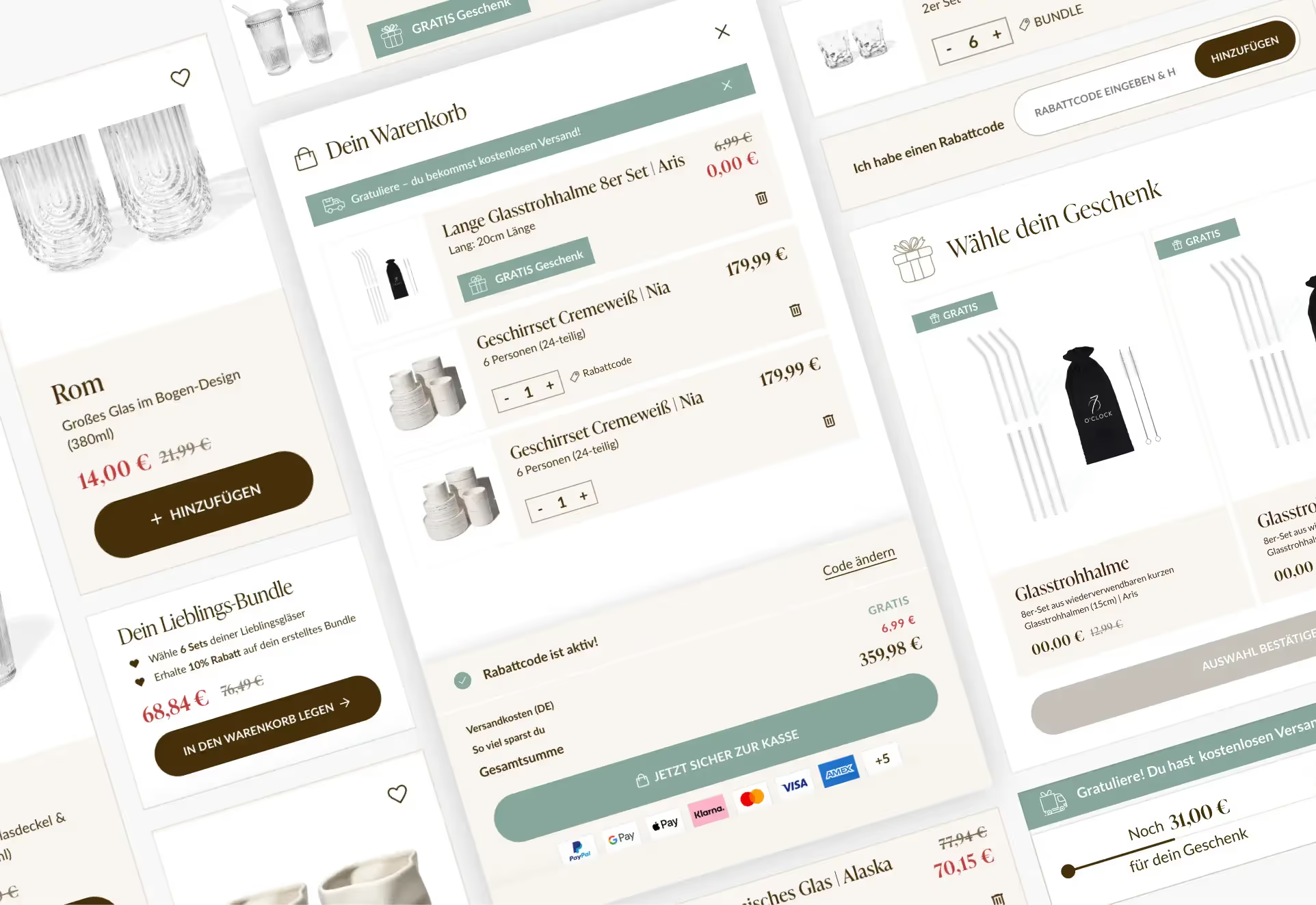
A Shopify store can be up and running in just a few days. Legally, however, it’s far from ready. Anyone selling to consumers in Germany must comply with a long list of information and design requirements, and several new ones were added in 2026: the cancellation button (effective in June), the new packaging rules (effective in August), the EU warranty label, and stricter rules for environmental advertising (effective in September).
Shopify itself is an international platform. Many default settings, templates, and legal text generators are not tailored to German law. This is precisely where the typical risks of receiving a cease-and-desist letter arise.
This article provides an overview of the topics merchants with a Shopify store should be familiar with and the specific areas where Shopify requires close technical scrutiny. It outlines the general principles, not what applies in individual cases.
Note: This post is intended solely for general informational purposes and does not constitute legal advice. We are a Shopify agency, not a law firm. The content reflects our understanding as of October 2026. Laws and case law are subject to change. Only an attorney can determine, on a case-by-case basis, whether and which obligations apply to your store.
Key Points at a Glance
- As of June 19, 2026, online stores are required to have an electronic cancellation feature in accordance with Section 356a of the German Civil Code (BGB). According to the Händlerbund, Shopify does not yet offer a built-in solution for this.
- According to the Händlerbund's 2026 Warning Letter Study, missing or incorrect base prices are the most common reason for warnings under competition law.
- Shopify's legal text templates are not sufficient for German stores. Specialized providers offer integrations for Shopify.
- Shopify's cookie banner controls only Shopify's own tools and pixels, not manually inserted scripts.
- As of September 27, 2026, the EU Guarantee Label and stricter rules for advertising with environmental claims have been in effect.
- The link to the EU dispute resolution platform should be removed. The platform has been discontinued since July 2025.
Legal Documents: What a German Shopify Store Needs
The legal documents that an online store typically needs to provide to consumers include:
- Legal Notice pursuant to Section 5 of the German Data Protection Act (DDG)
- Privacy policy
- Terms and Conditions
- Cancellation Policy and Sample Cancellation Form
- Payment and Shipping Information
- a statement of accessibility, if applicable
Shopify offers a policy generator. Shopify itself points out that the templates do not constitute legal advice. It does not provide a cancellation policy based on the standard German legal template. Furthermore, Shopify’s own German blog post on the topic dates from 2021 and is outdated in several respects.
In practice, many retailers work with providers such as Händlerbund, IT-Recht Kanzlei, or Protected Shops. These companies offer Shopify apps that automatically import legal texts into the store and update them when laws change. This list is provided as an example only and does not constitute a recommendation.
The Cancellation Button Under Section 356a of the German Civil Code (BGB)
As of June 19, 2026, businesses that enter into distance sales contracts with consumers via an online platform must provide an electronic cancellation function. This requirement is based on an EU directive that was implemented in Germany as Section 356a of the German Civil Code (BGB). There was no transition period.
Essentially, the law states the following:
- The button is clearly labeled “Cancel Contract” or with an equivalent phrase.
- It is available at all times throughout the entire cancellation period, prominently displayed, and easily accessible.
- Only personal information, contract identification details, and a method for confirmation may be requested.
- This is followed by a second step with a button such as “Confirm Revocation.”
- The merchant must immediately confirm receipt, including the date and time, on a durable medium, such as by email.
If this feature is missing, the cancellation period may be extended to up to twelve months and 14 days. The first warnings regarding missing cancellation buttons were issued in the summer of 2026.
Implementation in Shopify
According to Händlerbund, Shopify’s return features in the customer account do not replace the right of withdrawal. Merchants therefore implement this functionality using an app, a module from their legal text provider, or a custom development within their theme. The right of withdrawal notice itself also had to be adapted accordingly. Anyone who last updated their legal texts before June 2026 should review this.
The Order Button Pursuant to Section 312j of the German Civil Code (BGB)
The button used to complete an order must clearly indicate that payment is required. The law cites “order with obligation to pay” as an example. Without the correct wording, a valid contract is not formed, and the online store risks receiving a warning letter.
In Shopify, the default label for the checkout button in the German language version is “Buy Now.” While this is often considered sufficient for standard sales contracts, it is viewed critically for subscriptions or memberships. It’s important to test the final button in a real test order, including on a smartphone and with express payment methods such as PayPal or Shop Pay. The labeling for these methods can only be customized to a limited extent.
Anyone who sells subscriptions must also include a cancellation button in accordance with Section 312k of the German Civil Code (BGB).
Pricing Information: Base Price, Shipping Costs, Strikethrough Prices
The Price Indication Regulation requires that consumers be shown the total price, including sales tax, and be informed of shipping costs before placing an order. For goods sold by weight, volume, length, or area, a base price must also be indicated, such as per kilogram or liter.
According to the Händlerbund’s 2026 Warning Letter Study, 23 percent of competition law warning letters concern the base price. This makes it the most common single reason for a warning letter. Shopify can display base prices via the unit prices in product variants. Whether they appear in all necessary places within the theme—including category pages, search results, and quick view—must be checked on a case-by-case basis.
Promotional Prices and Discounts
Anyone advertising a price reduction must, pursuant to Section 11 of the PAngV, state the lowest price of the past 30 days as a reference point. The European Court of Justice confirmed this in September 2024. The Federal Court of Justice ruled in October 2025 that this reference price must be clearly identifiable. Accordingly, a note in a footnote is not sufficient. Shopify’s comparison price feature does not automatically calculate this 30-day price.
EU Quality Assurance Label and GARAN Label
Starting September 27, 2026, online stores that sell goods to consumers in the EU must display a standardized notice regarding the statutory warranty. If a manufacturer offers a free durability guarantee of more than two years on the entire product, the GARAN label must also be displayed. Both graphics are specified by the European Commission. All the details, including placement within the Shopify theme, can be found in our article on the EU warranty label and the GARAN label.
Advertising with Environmental Claims
Stricter rules for environmental advertising have also been in effect since September 27, 2026. These rules stem from the EU Directive on Empowering Consumers for the Green Transition and were implemented in the Unfair Competition Act. According to widespread assessment, this means:
- General claims such as “environmentally friendly,” “green,” or “sustainable” are now permitted only if backed by evidence of recognized outstanding environmental performance.
- Sustainability labels are permitted only if they are based on a certification system with independent oversight or are established by the government.
- Advertising that claims climate neutrality through offsetting is strictly limited.
There is no grandfather clause for existing product text. Product descriptions, banners, seals, and meta descriptions should therefore be reviewed.
Product Safety Under the GPSR
The EU Product Safety Regulation (GPSR) has been in effect since December 13, 2024. For online offerings, it requires, among other things:
- Manufacturer's name, brand, mailing address, and email address
- For manufacturers outside the EU, a designated representative in the EU
- Information used to identify the product, such as an image, model number, or lot number
- Warnings and safety instructions in the consumer's language
In Shopify, this information can be managed using meta fields on a per-product or per-manufacturer basis and displayed in the theme. Reports of warnings issued due to missing manufacturer information have been emerging since 2025. In Germany, the Product Safety Act was amended in February 2026 to align with the GPSR.
Packaging, Electrical Appliances, Batteries, Textiles
Packaging
The EU Packaging Regulation has been directly applicable since August 12, 2026. In Germany, a new implementing law replaced the Packaging Act at the same time. Registration in the LUCID packaging registry, participation in a dual system, and volume reporting requirements remain in effect. The definition of who exactly qualifies as a manufacturer has been partially revised. Retailers should verify their registration.
Electrical Appliances and Batteries
Anyone who sells electrical appliances generally needs to be registered with the ear Foundation and must provide information about take-back and disposal. An amendment to the Electrical Equipment Act has been in effect since January 2026, and a standardized take-back logo has been in use since July 2026. For batteries, the Battery Law Implementation Act replaced the old Battery Act in October 2025. Anyone who sells batteries from unregistered manufacturers may be considered a manufacturer themselves.
Textiles
For textiles, the fiber composition must be specified before purchase, including the exact fiber names and, for multi-part products, for each component.
Customer Reviews
Anyone who displays customer reviews must, pursuant to Section 5b(3) of the German Unfair Competition Act (UWG), state whether and how they verify that the reviews come from customers who have actually purchased or used the product. This notice must appear near the reviews. The Deggendorf Regional Court ruled on this matter in March 2026; the appeal is pending. Review apps for Shopify offer various verification mechanisms. The notice must correspond to what the app actually does.
Privacy and Cookies in Shopify
Contractual Partners and Data Transfer
Merchants based in Europe enter into their agreement with Shopify International Limited in Ireland. The Data Processing Agreement is part of the Terms of Service. For data transfers within the Shopify Group, Shopify has been using Binding Corporate Rules—internal data protection regulations approved by the Irish Data Protection Authority—since October 2025. Every installed app that processes customer data is considered a separate service provider and must be included in the privacy policy.
The Shopify Cookie Banner
Shopify has its own cookie banner that can be automatically enabled for visitors from the EU. It applies to the store, shopping cart, checkout, and customer account. Important to note: It only controls Shopify’s own features and pixels that are integrated via customer events. It does not block scripts that have been manually added to the theme.
Anyone using an external consent provider must integrate it with Shopify’s Customer Privacy API. For Google Ads and Google Analytics, Consent Mode version 2 is also required. The transfer of consent from Shopify to Google does not work seamlessly in every setup and should be verified using a test purchase.
Newsletter
The double opt-in procedure has become the standard for newsletters. In April 2026, the Munich Higher Regional Court ruled that consent to receive a newsletter may not be tied to registration in the online store. Therefore, the checkbox for newsletter subscription in the Shopify checkout should not be preselected.
Accessibility under the BFSG
As of June 28, 2025, online stores that sell to consumers are generally subject to the Accessibility Enhancement Act. Exempt from this requirement are micro-enterprises with fewer than ten employees and an annual revenue or total annual assets of no more than two million euros.
In practice, the standard is EN 301 549, which aligns with WCAG 2.1 Level AA. This includes an accessibility statement. Themes in the Shopify Theme Store must meet certain minimum thresholds during automated testing. This is a good starting point, but it does not guarantee full compliance: apps, images, text, and customizations also play a role. Read more about this in our article on the Accessibility Enhancement Act.
AI in the Store: Chatbots and Generated Content
As of August 2, 2026, AI chatbots must, in accordance with Article 50 of the AI Regulation, make it clear to customers that they are speaking with an AI, unless this is already obvious. This also applies to chat apps in Shopify stores. AI-generated images or videos that appear deceptively real must be labeled as such.
Dispute Resolution: Remove OS Link
The EU shut down its online dispute resolution platform on July 20, 2025. The link, which was previously mandatory, should be removed from legal notices, terms and conditions, order confirmation emails, marketplace profiles, and social media pages. The requirement under Section 36 of the Consumer Dispute Resolution Act to state whether the online store participates in mediation proceedings remains in effect. Businesses with ten or fewer employees are exempt from this requirement.
How Much Do Cease-and-Desist Letters Cost?
According to the Händlerbund’s 2026 Cease-and-Desist Study, 9 percent of the retailers surveyed received a cease-and-desist letter in the previous year. Just under half of the cases involved competition law, and about a quarter involved copyright law, mostly regarding images. In 41 percent of the warning letters, the costs ranged from 1,001 to 2,000 euros, and in 19 percent, they exceeded 3,000 euros. New issues leading to warning letters include the cancellation button, manufacturer information under the GPSR, the authenticity of reviews, and the outdated ODR link.
Checklist for Your Shopify Store
These points are a starting point for a discussion with an attorney or legal document provider; they are not a final review.
- Legal texts from a specialized provider, with automatic updates
- Cancellation Policy as of June 2026
- Electronic cancellation feature implemented and tested
- Order button tested during checkout in a test order
- Base prices are clearly displayed in all necessary locations
- Deal prices showing the lowest price over the last 30 days
- Shipping costs and delivery times are visible before placing an order
- EU warranty notice and, if applicable, the GARAN label have been included
- Product descriptions and seals reviewed for environmental claims
- Manufacturer specifications in accordance with GPSR on all product pages
- Registrations for Packaging, Electrical Appliances, and Batteries Reviewed
- Note on Verifying the Authenticity of Customer Reviews
- Cookie banner active; manual scripts linked to consent
- Newsletter with double opt-in; checkbox not preselected
- Determining whether the BFSG applies, and if so: Implementation and accessibility statement
- AI chatbot with a clear notice, if available
- OS-Link removed, VSBG notice reviewed
What we support and what we don't
As a Shopify agency, we handle the technical side: setting up legal text interfaces, integrating the cancellation button into the theme, displaying base prices and manufacturer information via meta fields, incorporating the EU warranty label, connecting the cookie banner to all tracking pixels and Google Consent Mode, and ensuring accessibility in the theme. As part of our Shopify support services, we keep track of new regulatory requirements and implement them technically.
What we don’t do: draft legal documents, review them for legal compliance, or provide a binding assessment of the obligations that apply to your online store. For this, it’s best to work with a law firm specializing in IT and competition law or a provider that specializes in legal documents. If you’d like to outsource the technical implementation, you can reach us via the project inquiry form.
Frequently Asked Questions
Are Shopify's legal text templates sufficient for Germany?
Generally speaking, no. Shopify itself points out that the templates do not constitute legal advice. They do not include a cancellation policy based on the German model.
Does Shopify have a built-in cancellation button?
According to Händlerbund, not yet. This feature is implemented using apps, blocks from legal text providers, or custom code within the theme.
Is “Buy Now” an acceptable order button?
For standard sales contracts, this is often considered sufficient. The law cites “place an order subject to payment” as an example. Caution is advised for subscriptions and memberships. If in doubt, this should be reviewed by a legal professional.
Is Shopify's cookie banner sufficient?
It controls Shopify's own tools and pixels based on customer events. It does not track manually inserted scripts. Whether it is sufficient for a specific store depends on which services are integrated.
Does the OS link still need to be in the store?
No. The EU platform was shut down in July 2025. The link should be removed.
Does the BFSG apply to my Shopify store?
If you sell to consumers and are not a microbusiness, the answer is generally yes. The exact classification should be determined on a case-by-case basis.
Sources
- § 356a BGB, Electronic Cancellation Function
- § 2 Act to Strengthen Accessibility
- § 36 of the Consumer Dispute Resolution Act
- Händlerbund: Cancel Button in Shopify
- Händlerbund: 2026 Cease-and-Desist Letter Study
- Bitkom: Practical Guide to Implementing the Cancel Button
- IT Law Firm: Labeling the Order Button
- Noerr: Strict Requirements for Discounted Prices
- KPMG Law: The EmpCo Takes Effect
- Händlerbund: Implementing the GPSR in Your Store
- Central Packaging Registry: August 2026 Newsletter
- Shopify Help: Privacy Settings and Cookie Banners
- Shopify Help: Shopify Partners
- Bonn Chamber of Industry and Commerce: Shutdown of the EU Dispute Resolution Platform
Disclaimer: The information in this article has been carefully researched and reflects the legal situation in Germany and the EU as of October 2026. It is not a substitute for individual legal advice. We do not guarantee the accuracy, completeness, or timeliness of this information. Whether and which obligations apply to your online store can only be assessed on a case-by-case basis by an attorney. We provide support with the technical implementation but do not draft or review legal documents. The tools and providers mentioned are examples and do not constitute a recommendation.