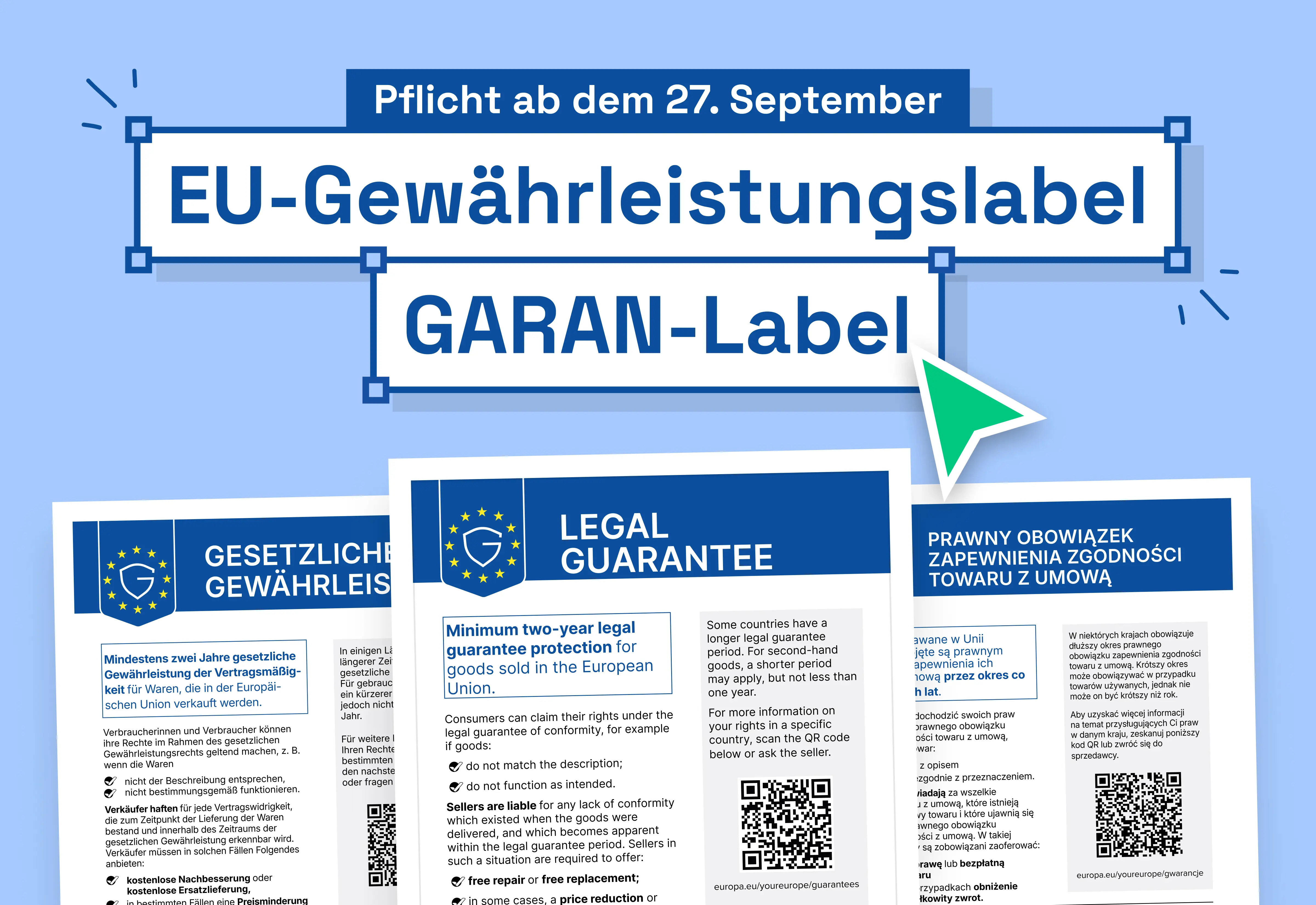
Starting September 27, 2026, every online store that sells goods to consumers in the EU must display the standardized warranty notice. This notice informs consumers that a statutory warranty of at least two years applies in the event of defects. What’s new is not this right itself, but the obligation to provide this information in a standardized and visible manner. In addition, the GARAN label will be used whenever a manufacturer offers a free warranty of more than two years on the entire product.
Both graphics are provided by the European Commission. They must be reproduced exactly as provided. Reproducing, recoloring, or translating them yourself is prohibited.
For Shopify stores, four questions are crucial: which products are affected, where the labels appear in the theme, how they are included in the order confirmation, and how multiple storefront languages are handled. This article goes through them one by one.
Note: This article reflects our assessment based on practical project experience and is not a substitute for legal advice.
What the warranty label is and when it takes effect
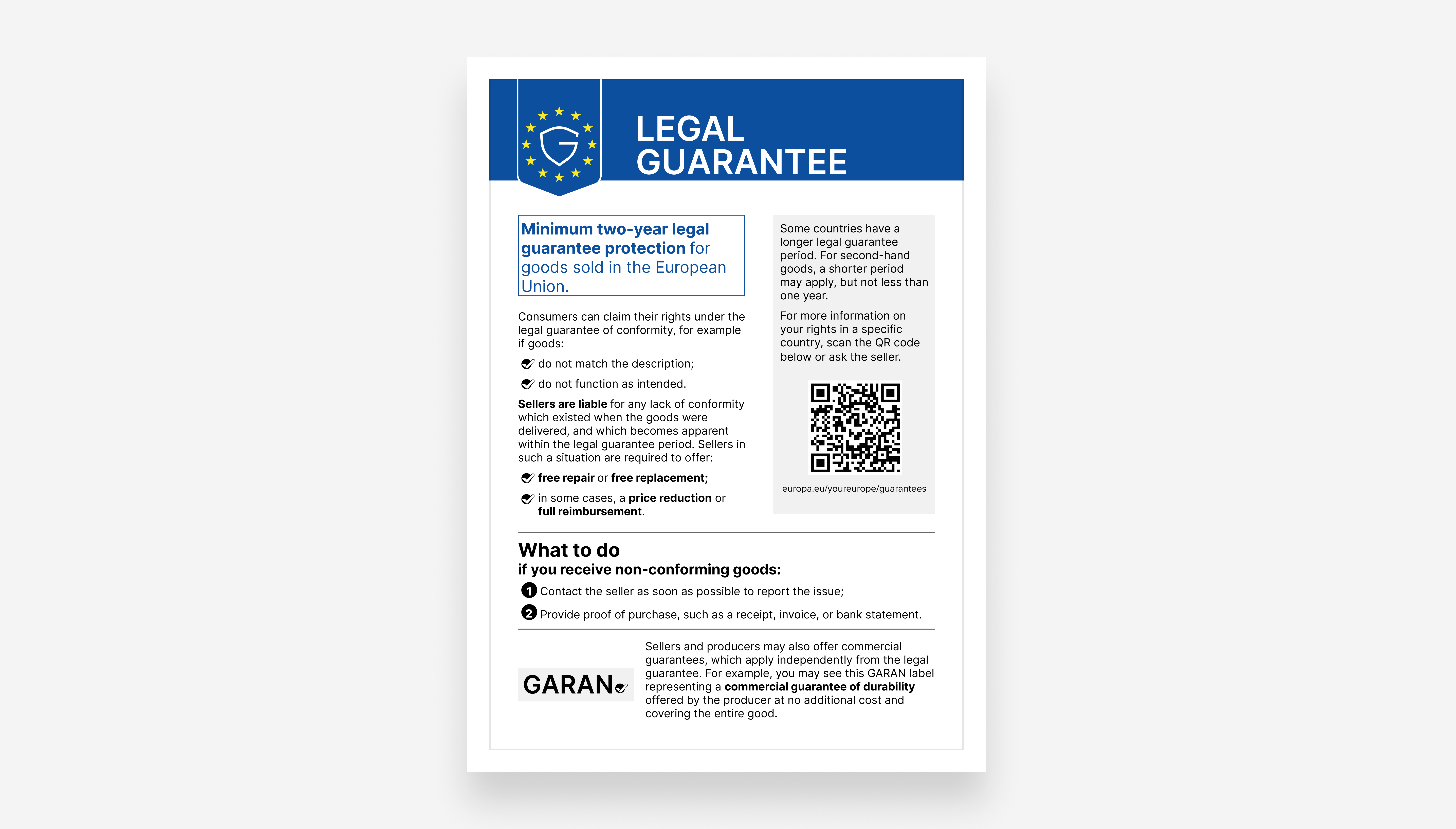
The warranty notice is a standardized EU graphic. It informs consumers that goods are covered by a statutory warranty of at least two years. The seller is liable for defects that existed at the time of delivery, and the rights arising from this warranty are provided free of charge: repair, replacement, or, in certain cases, a price reduction or refund.
These two-year periods have existed in the EU for years. They are set forth in the Directive on the Sale of Goods (EU) 2019/771 and, in Germany, in §§ 434 et seq. of the German Civil Code (BGB). The only new element is the requirement for consistent communication. The reason: Many consumers do not understand the difference between a warranty and a guarantee, and that is precisely what the infographic is intended to change.
Two legal acts are intertwined, and this distinction explains almost all misunderstandings:
- Directive (EU) 2024/825 establishes this requirement. It inserts a new Article 22a into the Consumer Rights Directive 2011/83/EU, but does not specify what the graphic should look like.
- Implementing Regulation (EU) 2025/1960 specifies the design and content: Annex I sets forth the notice, and Annex II sets forth the GARAN label. Pursuant to Article 3, it takes effect on September 27, 2026.
A regulation is directly applicable in all Member States. Therefore, there is no separate German version and no room for interpretation.
Who Is Affected and Who Is Exempt
The following are excluded:
- purely B2B stores, because the Consumer Rights Directive applies only to contracts with consumers
- Purely digital content and services not related to goods
When it comes to digital products, it’s worth taking a close look at the guideline, as it distinguishes between two consecutive subsections. Subsection l requires that the graphic for goods be highlighted. The immediately following subsection lb, on the other hand, requires only “a notice regarding the existence of the statutory warranty right for digital content and digital services” for digital content and services.
No “in a prominent manner,” no harmonized graphic. For downloads, gift certificates, courses, and services, the graphic would actually be factually incorrect. Your text refers to goods, and the warranty for digital content is based on Directive (EU) 2019/770, not 2019/771.
The following are not excluded:
- perishable and consumable goods
- Used goods. The warranty period may be reduced to one year in such cases, but the graphic must still be included.
If you carry a mixed assortment, it's best to select digital items by product type, tag, or collection rather than maintaining individual products. This way, the rule will also apply to future items.
Official Label Downloads
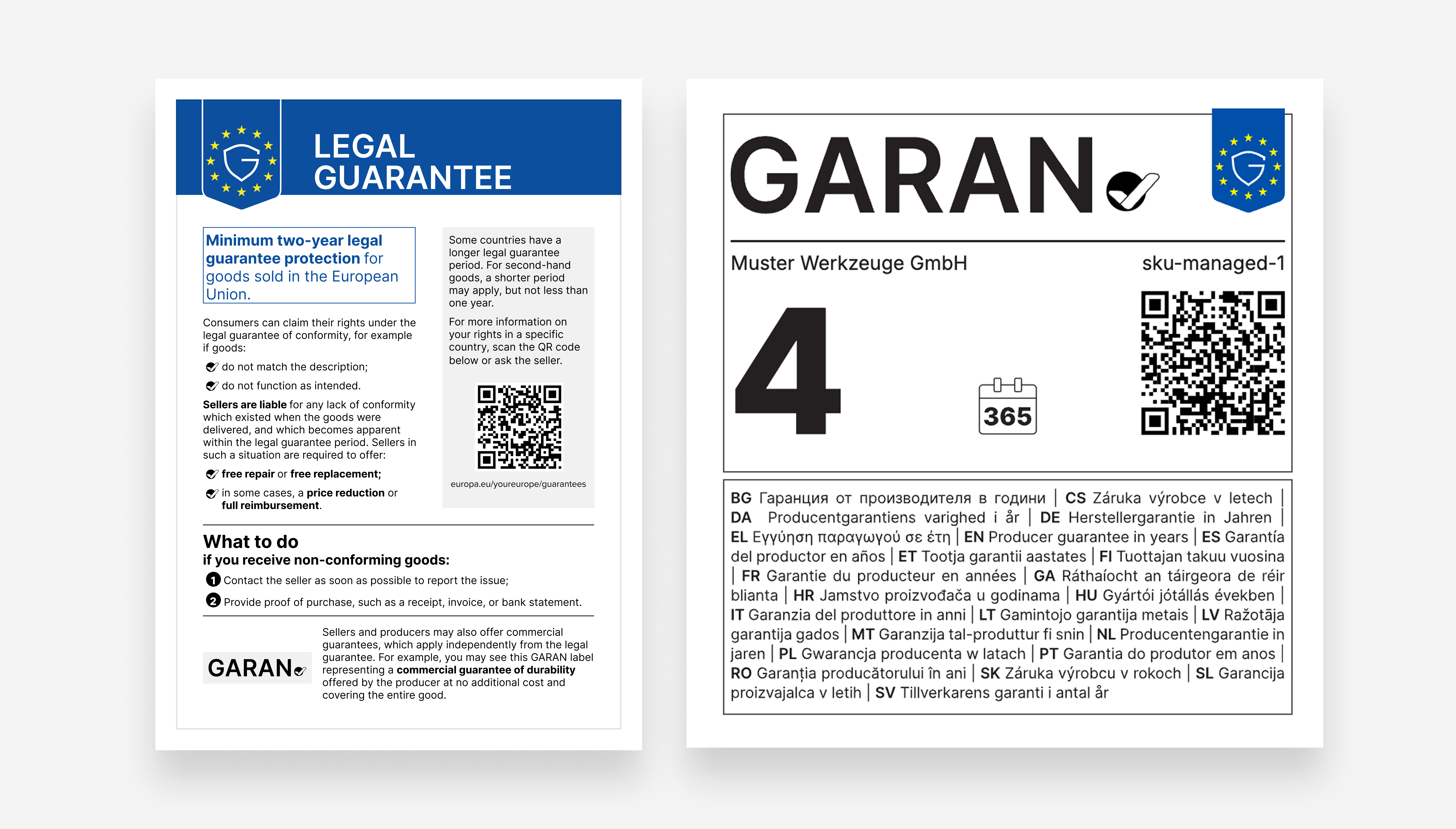
The Commission provides all files free of charge: the warranty notice in 24 EU languages, in color and black-and-white, as well as the GARAN template in color, black-and-white, and as an embedded version for e-commerce. For both graphics, the color version should be used online; the black-and-white version is for offline use.
When comparing the files with the text of the regulation, a discrepancy becomes apparent. The appendices list #003399 and #FFED00 as reference colors, while the published vector files use #034ea2 and #fff200. (Verified on September 7, 2026, in the original file) Anyone who recolors the file to match the values specified in the text is altering the official graphic, and that is precisely what Annex I, Note 1 prohibits. The safer option is to use the unmodified file. Only a legal review by an attorney can provide a definitive answer to this discrepancy.
Warranty Label or GARAN Label: What Is Required and When
The warranty notice is mandatory for all B2C stores; there is no option to opt out. The GARAN label is only added under certain conditions and may not be used without meeting those conditions.
When the GARAN label will also become mandatory
It becomes mandatory as soon as all four points apply:
- The warranty is provided by the manufacturer, not the retailer.
- It's free.
- It applies to the entire product, not just individual parts.
- It has been running for more than two years. Exactly 24 months isn't enough.
Here's an example: a five-year free manufacturer's warranty on a complete washing machine. A three-year warranty on the battery alone does not qualify for the label, nor does a paid warranty extension, nor does a two-year warranty offered by the retailer.
The manufacturer must inform the dealer
Article 6, paragraph 1, subparagraph (la) states the dealer's obligation as follows:
“if the manufacturer […] provides a commercial durability guarantee at no additional cost for all of the goods, with a duration of more than two years, and makes this information available to the business operator, the information that such a guarantee applies to these goods […]”
The highlighted phrase is a prerequisite. The obligation arises only after the manufacturer has informed the dealer. No one has to comb through data sheets to see if a warranty is hidden somewhere.
In practice, this means: Contact the suppliers—one line per brand is enough. Is there a free two-year manufacturer’s warranty on the entire product, and if so, how long does it last? The answer determines whether the store is obligated to cover it and also serves as proof that the store has followed up on the matter. Keep the email with the date on file.
Warranty and Guarantee: A Comparison
Both terms sound similar, but they have different legal meanings:
- Basis. Warranty: required by law. Durability guarantee: voluntary.
- Covered. Warranty: Defects that existed at the time of purchase. Guarantee: Also covers defects that arise during use.
- Duration. Warranty: two years. Guarantee: varies; for the GARAN label, more than two years.
- Example. Warranty: The seam on a pair of jeans tears after a few weeks—usually due to a manufacturing defect. Guarantee: Five years on a washing machine.
The GARAN label displays exactly three fillable fields: the number of years in large digits, along with the make and model code. Nothing else is allowed on it.
3. Where the labels may be placed
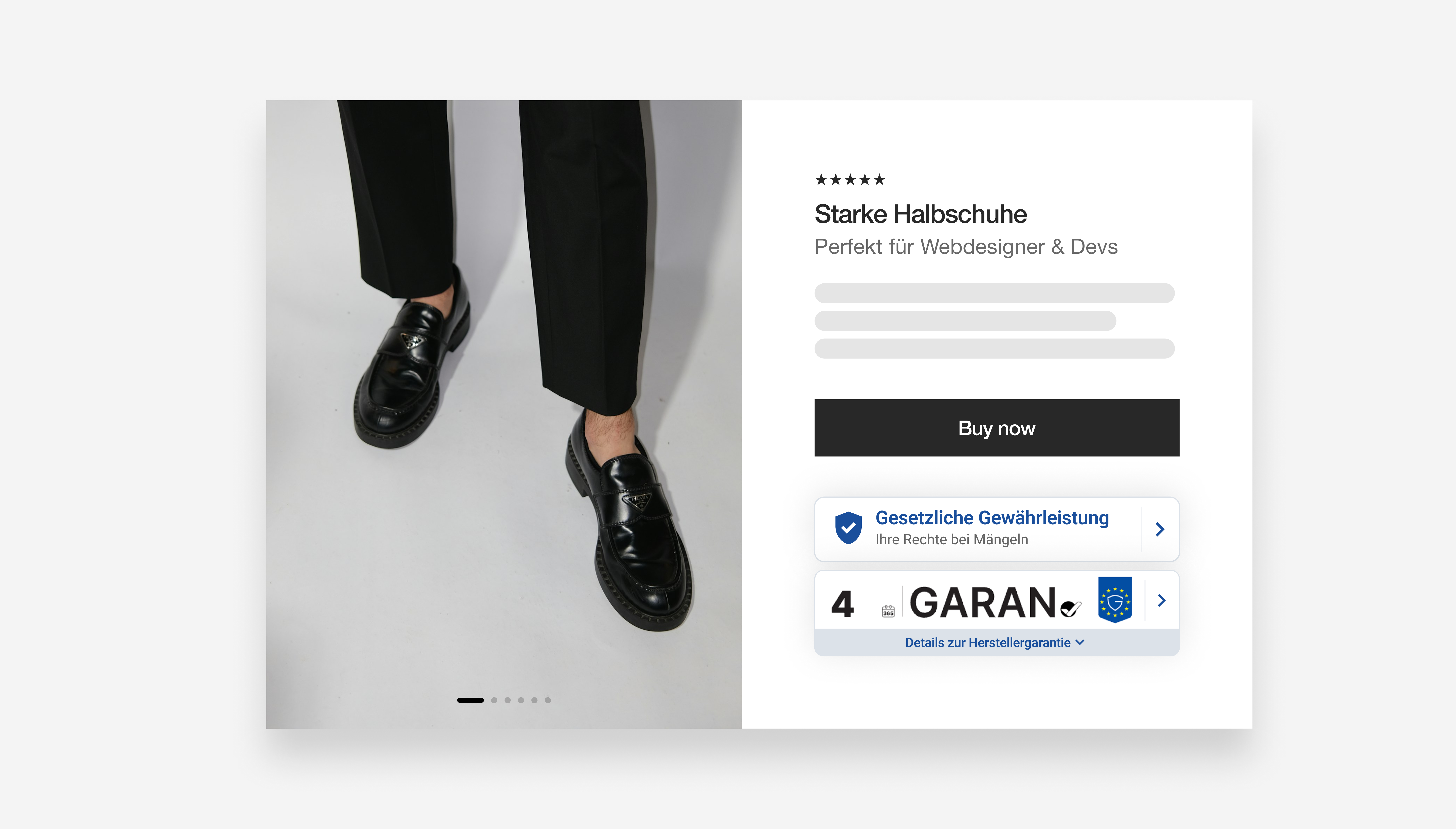
The regulation governs the design of the graphics, not their location. The location is determined by the Consumer Rights Directive, and it is specified in the text of that directive. Article 6, paragraph 1, begins as follows:
“Before the consumer is bound by a distance or off-premises contract, or any corresponding offer, the trader shall provide the consumer with the following information in a clear and comprehensible manner.”
This information is therefore provided prior to the contract. A notice that the customer only sees in the order confirmation comes too late. A notice that appears only in the footer of the home page is less effective because there is no way to prove that the customer saw it before clicking “Buy.”
Eligible Placements
- Warranty Notice: Product page, category page, header, shopping cart. The product page and shopping cart are the safest places because that's where the purchase decision is made.
- GARAN label: on the product page, as a standalone image in the product gallery, as part of a product image, or near the order button.
The EU Practical Guide also mentions the checkout page. In Shopify, integration there is not feasible without the Plus plan, which is why, in practice, the product page, header, and footer remain the only options. The examples in the guide are expressly not exhaustive. Article 8, paragraph 2, requires that orders subject to payment include the information specified in subparagraph (la), namely the shelf-life guarantee,
“clearly and prominently, and immediately before the customer places an order”
The GARAN label should therefore appear immediately before the "Order" button—not in the product description and not in an accordion section further down the page. The note itself—letter l—is not included in this list.
Nested Display
To keep a product page uncluttered, it makes sense to display only a short line and open the full image when the user clicks on it. The GARAN label explicitly permits this; Annex II states:
"In the case of a nested ad, the harmonized label must appear in its entirety upon the first mouse click, the first mouse rollover, or the first touch or swipe on a touchscreen."
So a compact bar is sufficient as long as a single click is all it takes. An accordion that first opens up and then contains another link does not meet this requirement.
Annex I does not contain a comparable authorization for the warranty notice. Its five explanatory notes address editability, colors, QR codes, and dimensions; there is no mention of a collapsed format. In addition, Article 6(1)(l) requires that the information be provided “in a prominent manner.” The EU Practical Guide does, however, also show the nested layout for the notice. Anyone who uses it should make a conscious decision to do so and document it.
6. Always Include Labels: Order Confirmation and Package
A link in the online store is not sufficient for delivery purposes. Anyone who advertises a warranty is additionally subject to Section 479 of the German Civil Code (BGB) in Germany, regardless of the GARAN label—a fact that is often overlooked.
Paragraph 1 requires five pieces of information to be included in the warranty statement: a reference to the consumer’s statutory rights and a statement that the warranty does not limit those rights; the name and address of the warrantor; the procedure for making a claim; a description of the goods; and the terms of the warranty.
Paragraph 2 requires that the statement be provided to the customer on a durable medium no later than the time of delivery. The three characteristics of a durable medium, as defined in Article 2(10) of the Consumer Rights Directive, are: personally addressed, accessible at a later date, and capable of being reproduced unchanged.
An email meets all three requirements. A product page that can be changed at any time does not meet the third requirement. Therefore, a GARAN label in the online store does not satisfy § 479(2), and a link to it likely does not either: The European Court of Justice ruled in Content Services (C-49/11) that information accessible solely via a hyperlink is not considered to have been transmitted.
Limitations of the Native Order Confirmation
Shopify does not allow file attachments in the native order confirmation email, not even with Shopify Plus. A PDF always requires an additional, separate email. However, embedding the label as an image works natively through the email template’s code editor, and this functionality is language-specific.
Two Feasible Approaches
- Image in the order confirmation. Embed the label for each storefront language into the template via code editing. No additional shipping costs, no additional app.
- Print the label from the package. Print the label and include it with the shipment. This works regardless of deliverability or spam filters, and is the easiest way to provide proof in the event of a dispute.
The two are not mutually exclusive. If you want to play it safe, do both.
7. Multilingual Stores: Labels by Storefront Language
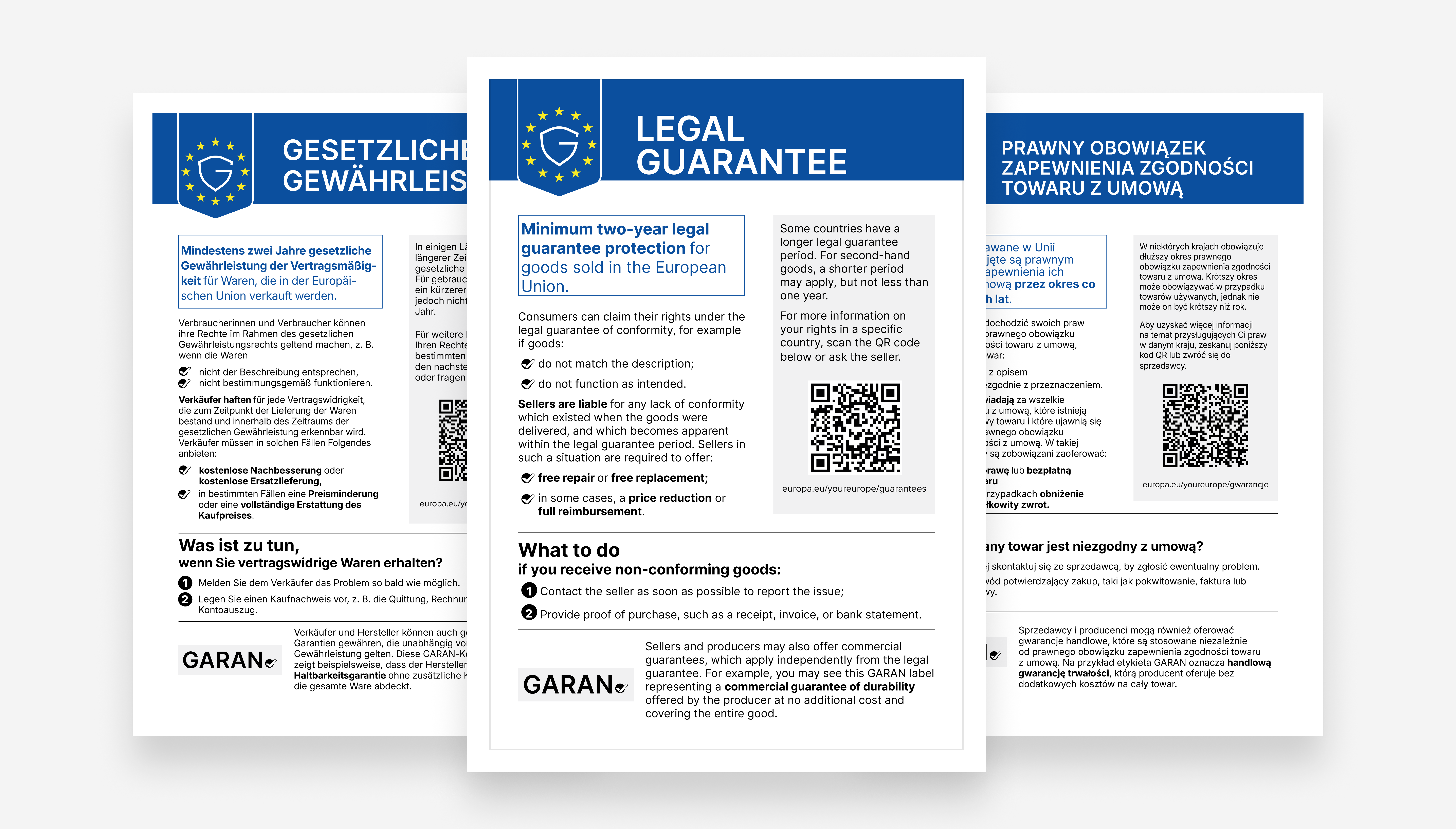
No element may be changed—not the text, not the colors, not the layout, and not the language. The Commission provides a separate file for each of the 24 official EU languages. A single language version for all storefronts does not meet the requirement.
What this means for implementation
For each Storefront language, the corresponding file from the official package is included. This applies to all display locations:
- the warranty information on the product page
- the GARAN label on the product page
- the label in the order confirmation
If you sell through multiple storefronts, it's best to plan for this step early on, because it affects all three points.
8. Checklist through September 27, 2026
The implementation can be divided into three phases: review, integration, and organizational support.
Check first
- Does the store sell exclusively to B2B customers? If so, there is no requirement. In all other cases, the warranty notice is required.
- Which items are considered digital content or services? These are excluded.
- Is there a free manufacturer's warranty on entire products that lasts longer than two years? If so, the GARAN label is included. Contact the manufacturers in writing to inquire about this.
Add to the store
- Include the warranty notice for each storefront language on the product page and in the shopping cart.
- If the GARAN label is required: fill it in individually and place it in the product-specific field, immediately before the "Order" button.
- Include language-specific labels as images in the order confirmation or print them out and place them inside the package.
- Gather warranty terms: address, procedures, covered goods, provisions. This is research that should begin early.
Ensure organizational support
- Brief customer service and sales. Visible labels lead to more questions, especially about the difference between warranty and guarantee.
- Keep track of the deadline of September 27, 2026, and the supporting documentation.
9. How We Implement It in Shopify
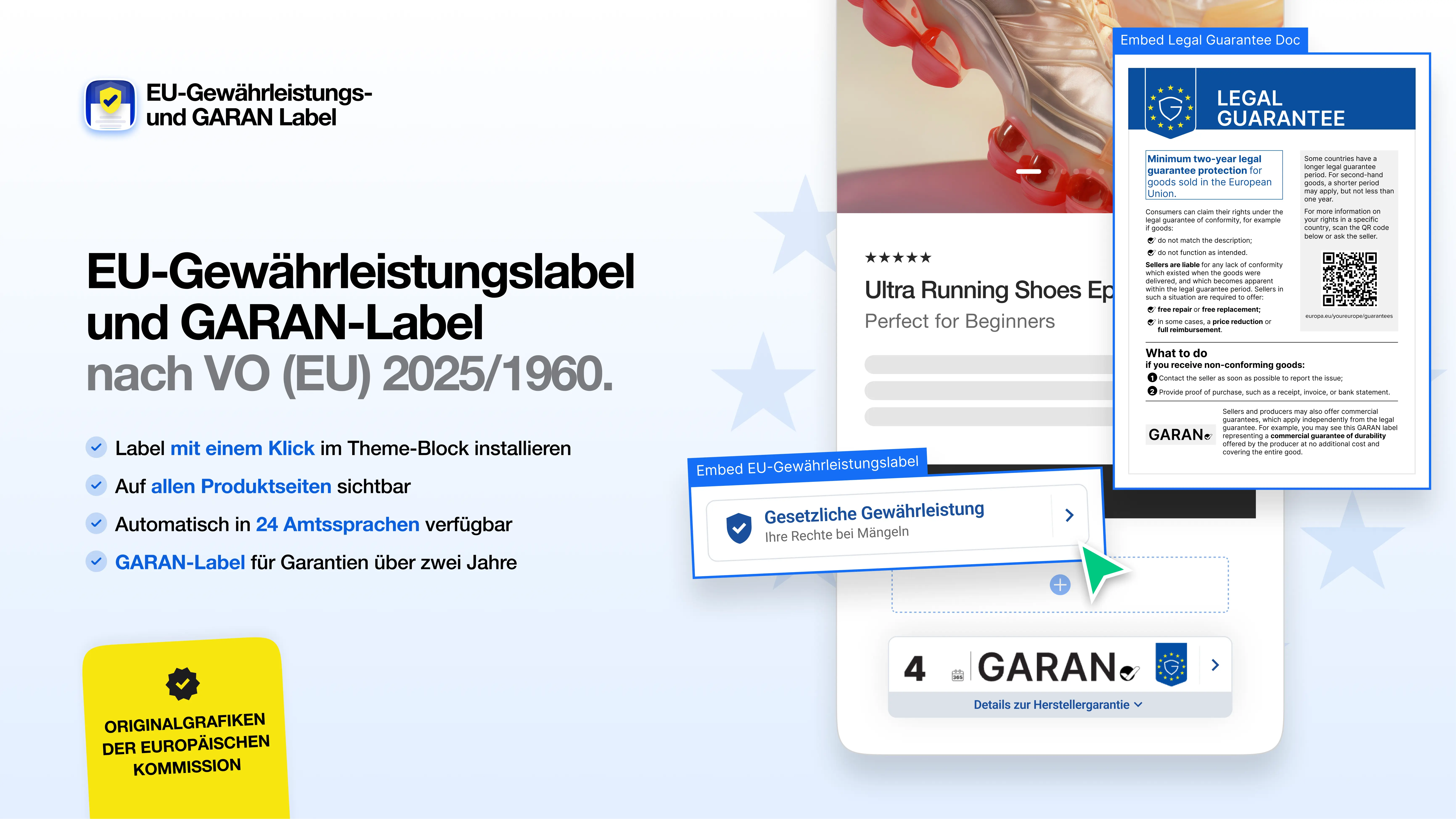
In our projects, we use the app " EU Guarantee Label" (GARAN) for this purpose.
- The graphics are the originals, in all 24 official languages, and each storefront displays the file for its specific language. Before each release, 36 automated checks compare the checksum and content against the Commission’s file. Nothing is recolored.
- It is automatically placed below the shopping cart button, on the category page, in the shopping cart, or in the page footer; alternatively, it can be placed manually in the theme editor. You can choose from the three display formats listed in point 4. For nested items, the app refers to the open question in Appendix I and records the decision along with the date and time.
- The GARAN label is assigned to each product. A duration of two years or less cannot be saved at all.
- Exceptions for downloads, services, and B2B can be set based on product type, tag, collection, individual products, or shipping requirements. The rules also apply automatically to new items.
- For Section 479 of the German Civil Code (BGB), the app generates a module for the order confirmation, which is inserted into the template.
The app does not read customer data, and it is not a substitute for a legal review. Nor does it relieve the retailer of the responsibility to consult the manufacturer.
Available in the Shopify App Store under " EU Warranty Label," GARAN.
All additional information on the EU warranty label and the Garan Label Generator.
We've been building Shopify stores for years and also handle the entire process on behalf of our clients: setup, integration into the theme, customizations for each product line, the warranty statement in the order confirmation, and multilingual support if needed. Request a project quote.
Frequently Asked Questions
When does this requirement take effect? On September 27, 2026, pursuant to Article 3 of Implementing Regulation (EU) 2025/1960.
Is it permissible to reproduce the graphic or translate it yourself? No. Note 1 of Appendix I prohibits any modifications. There is a separate official file for each official language.
Does the notice have to appear on every product page? The regulation governs the format, not the location. Because the information is provided prior to the conclusion of a contract, the product page and shopping cart are the safest places to display it.
Is the GARAN label necessary if the retailer offers its own two-year warranty? No. It applies to manufacturer warranties that last longer than two years.
What applies to digital products? A notice is required, but an official graphic is not. Article 6, paragraph 1, subparagraph (lb) requires only the notice.
Does this also apply to used goods? Yes. In that case, the period may be reduced to one year, but the obligation to provide information remains.
Does the label have to be in color? Online, yes—for both graphics. Black-and-white is allowed only offline.
What happens in the event of violations? Article 24 of the Consumer Rights Directive requires effective and deterrent sanctions, amounting to at least 4 percent of annual turnover in cases of widespread violations. In practice, however, a cease-and-desist letter under competition law is the more likely course of action in Germany.
Sources
- Implementing Regulation (EU) 2025/1960 of September 25, 2025, Recital 14, Article 3, Annexes I and II
- Directive 2011/83/EU, as amended on September 27, 2026: Article 2(10), Article 6(1)(l), (la), and (lb), Article 8(2), Article 22a, Article 24
- Directive (EU) 2019/771, Article 17, and Directive (EU) 2019/770 on digital content
- Directive (EU) 2024/825 on Empowering Consumers for the Green Transition
- European Commission, Practical Guidelines, April 2026
- § 479 of the German Civil Code (BGB) and the European Court of Justice, Judgment of July 5, 2012, C-49/11, Content Services
- European Commission, high-resolution vector files for notes and labels
As of September 2026; this is not legal advice. A review by an attorney is required to evaluate a specific store.