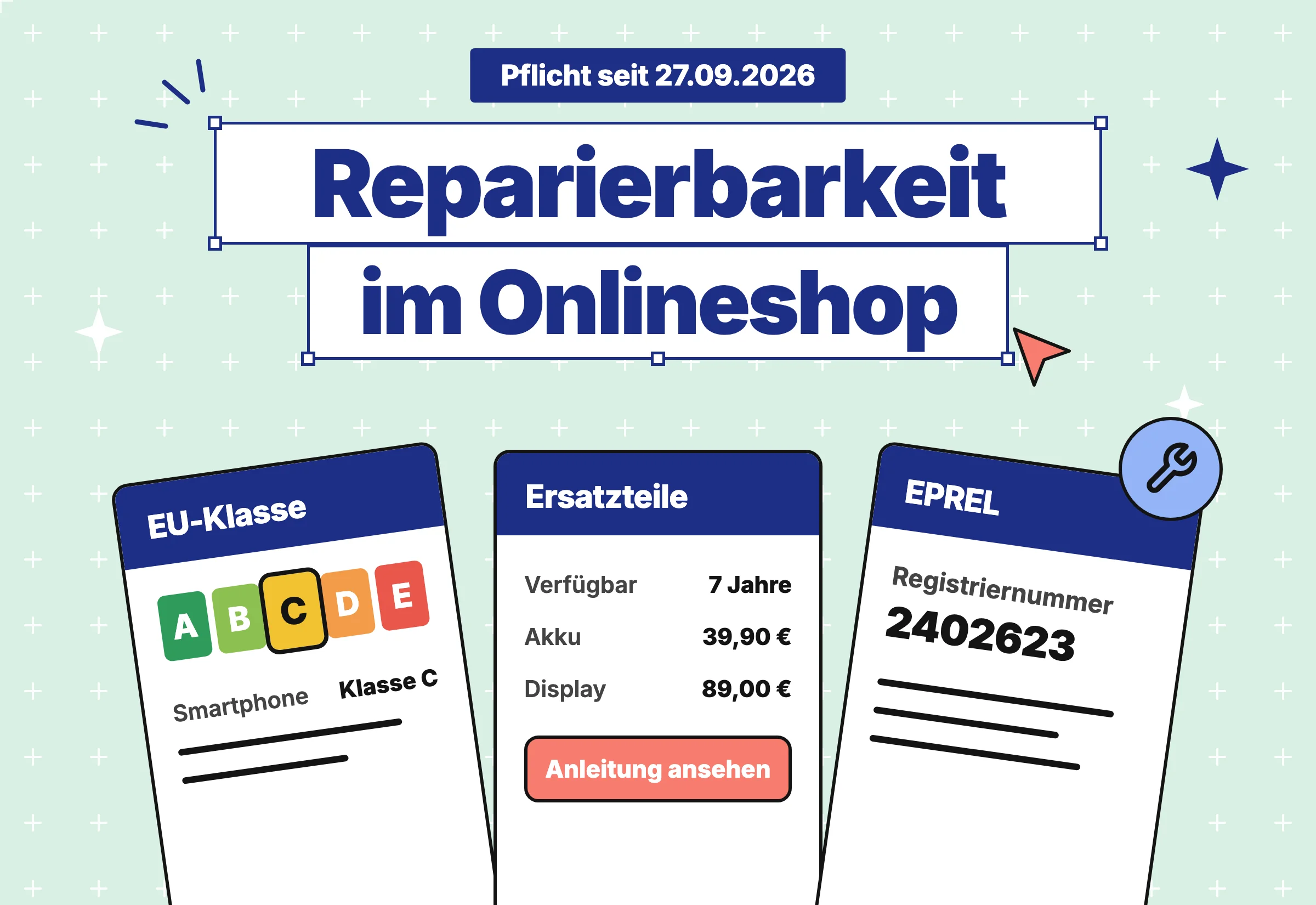
Anyone selling electronics or household appliances online has been required to include a new piece of information on their product pages since the fall of 2026. As of September 27, 2026, online stores must inform consumers of a product’s repairability before they place an order. This requirement is based on EU Directive 2024/825, which has been implemented in Germany under Article 246a of the EGBGB.
Many online stores aren't aware of this yet. That's understandable: The rules are spread across several EU regulations, and the data is stored in an EU database that hardly anyone knows about. We took a close look at this for our customers and developed our own project based on it.
Note: This post is intended solely for general informational purposes and does not constitute legal advice. We are a Shopify agency, not a law firm. The content reflects our understanding as of November 2026. Only an attorney can determine, on a case-by-case basis, whether any obligations apply to your store and, if so, which ones.
Key Points at a Glance
- As of September 27, 2026, information regarding repairability must be included on the product page prior to purchase (Art. 246a, § 1, para. 1, nos. 20 and 21 of the EGBGB).
- If there is an EU repairability rating, the store will specify it. Currently, this is the repairability class, ranging from A to E, for smartphones and tablets.
- If none are available, the store will provide information on replacement parts, costs, how to order, instructions, and restrictions, to the extent that the manufacturer makes this information available.
- This obligation applies to consumers, as well as to marketplace sellers and online stores outside the EU that sell to consumers in the EU.
- Effective July 31, 2026, the right to repair also applies, along with a new obligation for sellers to provide information.
Two Levels: Repairability Score or Spare Parts Information
The requirement has two levels. If a product has a Union repairability rating, the retailer must state it. As of June 20, 2025, this rating applies to smartphones and slate tablets: repairability classes A through E on the energy label (Regulation (EU) 2023/1669). For clothes dryers placed on the market on or after January 1, 2027, an additional class will be added.
For all other products, the store provides the following information, to the extent that the manufacturer makes it available:
- Availability of Replacement Parts
- estimated cost of replacement parts
- How to Order Replacement Parts
- Repair and Maintenance Manuals
- Repair Limitations
Important for practical application: Retailers do not need to search manufacturer websites. What matters is the information the manufacturer provides on the product, packaging, or label (Recital 36 of Directive 2024/825). The information must be available before the order is placed, but does not need to be repeated directly on the order button.
Right to Repair
This is distinct from the right to repair under Directive (EU) 2024/1799. For sales contracts entered into on or after July 31, 2026, the statute of limitations is extended once by twelve months following a repair (§ 475e(5) BGB). The seller must provide prior notice of this (Section 475(4) of the German Civil Code (BGB)). For smartphones and tablets, consumers may also request a repair from the manufacturer for a fee, even after the warranty has expired.
Anyone who sells to France
France has its own "indice de réparabilité." It applies to laptops, dishwashers, and vacuum cleaners, among other items. Televisions and washing machines there are labeled with the "indice de durabilité." Online stores that ship to France should also keep these ratings in mind.
What Stores Should Do Specifically
- Check the product lineup: Which products have an EU repairability score, and which do not?
- Find the energy class: For smartphones and tablets, the energy class is listed in the EU database EPREL. You can find it using the EPREL registration number on the energy label.
- All other products: Gather information on replacement parts, costs, ordering procedures, and instructions. If anything is missing, contact the manufacturer and document the inquiry.
- Include it on the product page: make it visible before the purchase, not just in the energy label PDF.
- Add the following to the legal text: a reference to the extended statute of limitations following a repair.
Common Mistakes
- The energy class is listed only in the energy label PDF, not on the product page.
- Variants such as storage capacity or color have different EPREL numbers, but only one is listed in the store.
- Listings on the marketplace are often overlooked, even though the same requirements apply there.
In Germany, violations are primarily addressed under civil law, specifically through cease-and-desist letters issued under the Unfair Competition Act (UWG). Fines under Article 246e of the Introductory Act to the German Civil Code (EGBGB) are only considered in cases of widespread violations as part of coordinated EU enforcement efforts.
Implementation in Shopify
Shopify does not have its own fields for repairability. The information can be maintained using meta fields for each product or variant and displayed in the theme. With a large number of products, this quickly becomes time-consuming because the class must be retrieved from EPREL for each variant.
That's exactly why we built our own solution: RepairInfoEU, a Shopify app that retrieves the repairability class from EPREL and displays the required information on every product page, in 24 languages.
From Real-World Experience: repairinfo
Our work on online stores has led to the creation of a separate project: repairinfo. In addition to the Shopify app, it serves as a comparison tool for consumers, ranking smartphones, tablets, laptops, televisions, and household appliances based on their repairability and durability. The rankings are based on official data from EPREL and French indices. The methodology used for the evaluations is disclosed.
What we learned from this:
- The data is available, but difficult to use. EPREL is public, but it's hardly practical without a technical connection.
- Manufacturer specifications sometimes contradict each other. The grade and index don't always match.
- Automation pays off. With hundreds of products and variants, manual work is prone to errors.
What we support and what we don't
As a Shopify agency, we handle the technical side: displaying repairability information via meta fields or the app, integrating EPREL data, and seamlessly incorporating the display into the theme. What we don’t do: provide legal advice on which obligations apply to your store. If you’d like to outsource the technical implementation, you can reach us via the project request form. You can find an overview of all other obligations in our article “Making Your Shopify Store Legally Compliant.”
Frequently Asked Questions
When does this requirement take effect?
As of September 27, 2026, for online stores and brick-and-mortar retailers alike.
Does this requirement apply to all products?
It applies to goods for which an EU repairability score is available or for which the manufacturer provides information on replacement parts and repairs. It does not apply to businesses.
Where can I find the repairability class?
In the EU database EPREL, using the registration number on the appliance's energy label.
Do I need to check with the manufacturer?
No. What matters is what the manufacturer states on the product, packaging, or label.
Sources
- Directive (EU) 2024/825
- Regulation (EU) 2023/1669, Energy Labels for Smartphones and Tablets
- Directive (EU) 2024/1799, Right to Repair
- EPREL, European Product Database for Energy Labeling
Disclaimer: The information in this article has been carefully researched and reflects the legal situation in Germany and the EU as of November 2026. It is not a substitute for individual legal advice. We do not guarantee the accuracy, completeness, or timeliness of this information. Transparency Notice: repairinfo and the RepairInfoEU app are a personal project of Florian Blach, co-founder of Halbstark.