Why good copy is key to the success of a relaunch
A website can look as beautiful as you like in Webflow or Shopify (after all, that’s our job 😉), but if users land on a page and find a wall of text with no proper structure or tone of voice, they’ll quickly bounce.
In this case, having too much or too little text won’t do you any favors. And if there’s no proper keyword strategy to boot, search engines will end up being dissatisfied as well and penalize you with poor search results.
Yet well-written content is so valuable: on your digital storefront, it can engage visitors and answer their questions 24/7.
Know your goal… and your target audience
First, you need to define your strategy. And to do that, you need to know your goal. So you need to spend a little more time understanding your target audience —after all, they’re the ones you’ll ultimately be writing for and trying to convince.
First, we need to see what industry you work in:
How to Structure Your E-Commerce Content
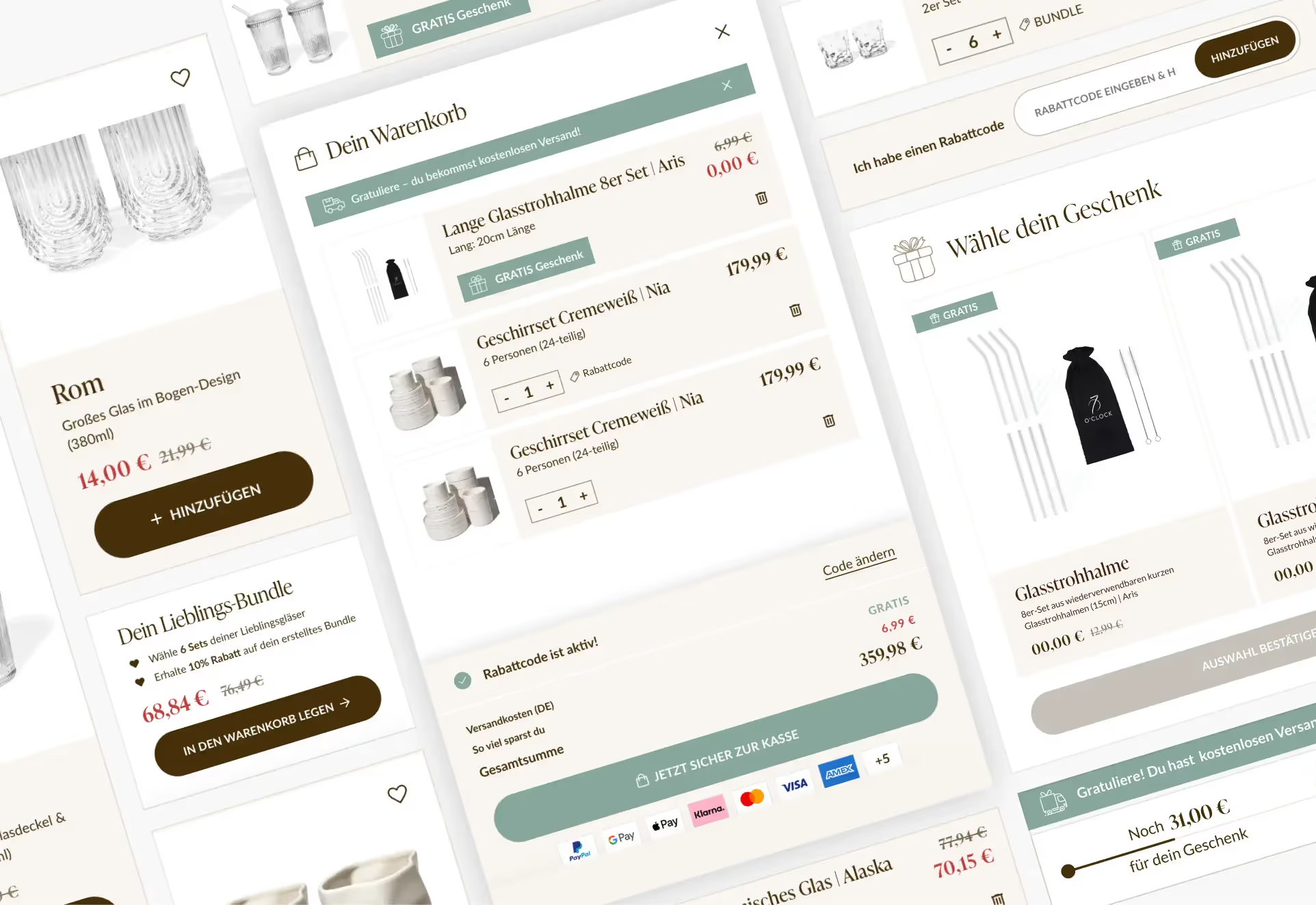
A Shopify relaunch is mainly about selling emotions and lifestyle —in other words, the feeling you get after making a purchase. Users want to be convinced and, ideally, make a quick decision.
So you should take the time to truly understand your target audience. Use your existing analytics data to build data-driven personas and identify the pain points of this audience.
Practical tips:
- Highlight the product’s benefits: Don’t just explain that the blanket is made of 100% organic cotton—explain how cozy your Sunday evenings on the couch will be with it.
- Incorporate social proof: You can include customer testimonials directly within the text. “Other customers especially love the high-quality material.”
- Proactively address objections: Effective copy addresses doubts before they even arise. Incorporate the solution directly into the body of the text.
- Supporting content: Create evergreen blog posts that interest your target audience and are likely to rank well in search engines. Address any questions or concerns your website visitors might have, and include links to your products in the articles.

How to Structure Your Content for Services
When relaunching a Webflow site in the services and consulting sector, the focus is more on trust and expertise. Above all, however, you should adopt your target audience’s perspective and describe the solution to their problem in detail. You’ll likely need to guide them through a longer decision-making process before they make an inquiry.
Practical tips:
- Address pain points: Show that you understand the customer’s problem. “Do you also feel like your marketing budget is going down the drain?”
- Visualize the results: Describe the situation after your service. How did you help the customer when they booked your service?
- Removing barriers: Explain the process. People are more likely to buy if they know what happens after the first click (e.g., “Get your new design in 3 steps”).
The golden rule: Don't write about yourself; write for your audience. So you need to shift from "We offer..." to "The benefit for you is...".
Headlines & Structure: The Anatomy of a Page
People don’t read text on the web like they would a novel—they scan it. Your headlines are essentially like little stopping points for the reader’s eyes. So you need to use these brief pauses to spark interest.
The heading hierarchy (H1 to H3)
The H1 is the most important element on every page. It’s the first thing users see and can determine whether they stay or leave. So don’t use it for cryptic wordplay; instead, say exactly what your target audience needs to know.
- Bad: “We help the visionaries of tomorrow.” → That could mean just about anything.
- Good: “We build websites for visionary B2B companies.” → Better, but still written from the first-person perspective.
- Even better: “Scalable websites without technical expertise for the B2B stars of tomorrow” → The target audience’s problem was identified, highlighted, and addressed in an emotionally resonant way
But keep in mind: The H1 tag should definitely include the most important keyword for that page.
Use H2 and H3 headings to logically structure your text. Each subheading should be worded in such a way that readers can understand the paragraph’s content without having to read the entire paragraph. Your keywords play an important role here as well; I’ll provide more information on this in a future blog post.

Powerful Taglines
Place your tagline (sometimes called an "eyebrow") directly above your H1 and H2 headings. In general, we can format taglines to look like taglines but technically set them as H1 tags. This gives you the freedom to be more emotional in your headlines and use the tagline for your most important keyword. Keep it short, snappy, and free of filler words.

Body text
No one reads long blocks of text anymore; our attention spans have become far too short for that. To hold people’s attention, you need to provide clear “anchors.” It’s better to use more sections with less text so that users can find all the information they need.
- Bullet points: Ideal for listing benefits or checklists.
- Keep your sentences short: Avoid nested sentences. One idea per sentence.
- Bold text: Highlight the most important keywords or statements within a paragraph in bold. This helps the scanner grasp the content in seconds. But don’t overdo it!
SEO: Placing Keywords Correctly
Search engine optimization isn't rocket science, even if it can be a bit of a headache now and then. If you keep a few basic things in mind, you'll be off to a good start and can continue to optimize your site later on (primarily based on analytics data).
Use the default
If we, as your agency, provide you with a primary keyword for each page, place it where it counts: in the H1 tag, in the first paragraph, in 1–2 H2 headings, and ideally in the metadata. But don’t overdo it. “Long-tail keywords” (i.e., entire phrases or questions) often sound more natural and still help improve your search engine rankings.
Write for real people, not just for the algorithm
It’s more important to answer a customer’s specific question than to mindlessly repeat a keyword 20 times. Google can tell whether a user stays on the page and finds the answer or leaves immediately (bounce rate). So always write for people. If the text engages the user, the algorithm will reward you too.
GEO, LLMS, AI
Optimized writing for AI is still a bit of a mess (at least at this point). What we can gather is that LLMs reference information in bullet points, definitive statements, and FAQs. Our general recommendation is to technically embed an llms.txt file—this is a Markdown file that serves as a structured summary and table of contents to help AI crawlers process the most important content.We’ve already summarized some informationon AI SEO for you here .
Why AI Should Be Used Only for the Structure
Tools like ChatGPT are great for quickly getting a rough outline for your text, but the resulting text often sounds generic and, at times, lacks substance.
The AI Trap
Texts generated purely by AI often sound generic and “lifeless.” They frequently rely on the same sentence structures, phrases, and bullet points. This is often easy to spot, which undermines the trust you’re trying to build with your website visitors.
AI as a Partner
It’s better to use AI just as an assistant to help you get started, so you can fill the blank page more easily.
- Have an outline created if you're not sure where to start.
- Use them to find synonyms and avoid repeating words.
- Afterward, let the system suggest improvements or check your spelling.
Conclusion
Good copy isn't something you can whip up in a hurry—it requires a lot of thought and a willingness to put yourself in your audience's shoes. Ultimately, good copy determines whether a visitor simply browses or becomes a customer. So take your time and don't underestimate the importance of content creation!
Are you finding that the writing process is more complex than you expected? Don’t worry. We’re happy to help you fine-tune your drafts or connect you with experts from our network who can assist you. Get in touch with us!